Jennifer has a lot going on in her life. She is a teenager. That should be explanation enough! She has relationships to manage: her friends, her family, her school teachers, and something that is taking an increasing amount of effort -> boys. Her body is doing all kinds of things, and pushing out in different directions, but not fast enough. She wishes her breasts were bigger. She wishes she were taller. Mostly, she just wants to be a woman and enjoy all the apparent privileges and power of female sexuality . But more than anything, she wants her freedom and her own identity.
Ever since Jen can remember, her life has been defined by being part of a family. She has always been her parent's daughter. She lives in a house selected by her parents. Her bedroom has delicate pink wallpaper because that is what her mother chose when she was little a little girl. Even her underwear is something that her mother bought on sale at a department store. It isn't what she would have bought for herself. In fact she feels like nothing is hers. She is just a possession for parents to show off when she pleases them, and to complain about when she embarrasses them.
Jennifer may not be sure exactly what she wants to be, but she knows one thing for sure: She does not want to be like her parents! The only way Jen knows how to build her own identity is to separate herself from all of the things that represent her parent's life. When they say white, she wants black. When they say up, she wants down. She wants to be different. She wants her own place in the world.
It is no surprise that after dinner one night Jennifer and her mother got into an argument over how to load the dishwasher. "Fine!" said Jen. "You know everything. You can do it yourself." And she stomped out of the kitchen, slamming the screen door to the porch behind her.
Sitting on the recliner on the porch was her Uncle Tim who was visiting from Argentina. Tim showed up every couple of years from different parts of the world. He was an archeologist who had spent time in Egypt, Africa, the Mideast, Greenland, and now South America. Uncle Tim was one of the coolest people Jen knew. He was so interesting, and so laid back. He traveled everywhere, knew everything, yet he was just a nice guy in his own unassuming way. And he always took an interest in Jen. He was one of the few adults who talked to her like an equal. He acted like she mattered. And he seemed genuinely interested in her opinions.
"Your mother giving you a hard time?" asked Tim.
"Yeah. It always has to be her way. Like she is some big expert on dishwashers or something!" Jen plopped herself down in a chair next to her Uncle Tim.
"Well it could be worse," said Tim. "I remember when your Mom and I grew up, we had to do the dishes by hand. Your grandmother would wash and your Mom would rinse. Then I would dry and put the dishes away. If your grandmother wasn't telling me what to do, your Mom was. I couldn't get out of the kitchen fast enough."
"I can't wait until I can leave and travel around like you. I can't stand it here."
"Your time will come soon enough," said Tim. "I know you don't think so, but when you get to be my age you will appreciate what it means to have a family like you have now. You know I had a fight with your grandfather and I never had the opportunity to go back home after I left. I always thought that someday I would return, but then he died and it just wasn't the same anymore. I lost something that I can never get back."
Jen looked surprised. She had never heard this before. "Did he like kick you out or something?"
Tim rolled up his sleeve. "See this tattoo? It was when I got this that all hell broke loose. My dad, your grandfather, went ballistic. It didn't seem like any big deal to me, but you would have thought I was an ax murderer or something. I didn't understand it then. It wasn't until I got into archeology that I figured it out."
What do you mean?" asked Jen. "What does archeology have to do with it?"
Tim pulled himself up in the recliner and pointed to the spiked dog collar around Jennifer's neck. "That collar you are wearing, and the black fingernail polish are what we call ornaments or symbols. They fall into the same category as jewelry. When you study archeology, one of the things you learn is that a significant event that separated man from all of the other animals around him was his use of symbols. Early man made tools. This was a first step up the ladder. There are a few other species of animals that use tools, but none to the extent that man had developed by the time of the Neanderthal. Tools were a major step, but jewelry was an even more significant developmental step. Jewelry is not functional. It is purely ornamental. Early humans may have collected shiny objects, shells, teeth or bones originally because they were simply different or looked nice. But soon those objects became associated with events. Keeping the tooth of a wild animal killed on a hunt was a reminder of the fight and the success of the hunt. Soon objects became associated with a person's bravery, power, wealth, skill, family relationship, or position in society. Jewelry and other ornaments are a statement that define who or what a person is, or is trying to be. My tattoo is no different than that collar you are wearing. It makes a statement, and your grandfather did not agree with the statement that I was making. You see, I thought I was free to say or do anything that I wanted. I didn't understand that responsibility comes with freedom. When you choose a style, whether it is an ornamentation, style of clothes, or a style of behavior, you are ultimately responsible for the consequences of the statement that you are making."
"I still don't get it. What is the big deal about being what you want to be?"
"There are several issues," said Tim. "There is being what you want to be, and there is advertising what you are or what you want to be. Are you using symbols correctly to present your intended identity? And is it really the identity that you want, or are you just experimenting with different ideas? The reason these things matter is because there are always consequences.
"Symbols were a hugely significant step in the development of man because when you can associate a finger with an object, and you realize that five fingers means five objects, you have the beginning of mathematics. If you understand that a picture on a cave wall can represent a place or an object, then you have the ability to draw maps. You also have the ability to tell stories with pictures, and eventually language can associate words with both picture symbols and actual objects or events. Ultimately you realize that words themselves can be a picture symbol when they are put down in the form of a written language.
"Because symbols evoke memories and emotions, symbols can be extremely powerful Think about the symbol of the cross in the Christian religion. Think about the power of the symbolism in a picture of someone burning the American flag. Symbols can conjure up very strong emotions.
"Do you remember I was talking to your Dad at the dinner table about something called the Nomothetic Theorem?"
Jennifer nodded her head. "Yeah. I was listening a little bit."
"Well your Dad and I were talking about economics. But the Nomothetic Theorem applies equally well to our discussion. The Theory of Stability says that all complex systems evolve toward increasing levels of stability. Society can be thought of as a very complex system. In spite of all the different people in a country like America, there is a center point that we can identify which represents what we think a normal person should be. We call this center point the "norm". You can think of the norm as being a perfect model citizen.
"We know most people aren't perfect model citizens. In reality we can't all agree on exactly what a perfect model citizen should look like. So we allow for a fair amount of differences which may move in different directions away from the norm. For example, you may dress like an old school "preppy" in traditional styles, or you may adopt the "grunge" look with baggy pants and a sweatshirt. You may choose to wear jeans and a cowboy shirt, or you may wish to look like a New York socialite. All of these fall into the range of acceptable appearance. The Theory of Volatility tells us to expect that there will always be some differences between people. Not only will appearance differ, behavior will also differ. Most of these differences will fall into the "normal range of volatility" that surrounds the "norm".
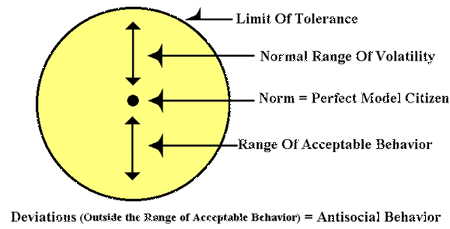 |
"The Nomothetic Theorem tells us that there is a limit to the normal range of volatility. In this example of social relationships, we will call this the limit of tolerance. Remember, I started out by saying that all complex systems naturally want to become stable. A society is formed around certain agreed upon concepts. Whether these concepts originated from a form of government or religion or a certain kind of family structure or something else isn't important to our discussion. What is important to understand is that whatever these agreed upon principles are, they will result in some definition of acceptable behavior. Perhaps more importantly, they will define certain behaviors that are not acceptable. Why? Because unacceptable behavior threatens the fabric that holds the society together. The system preserves itself by enforcing a code of conduct that rewards the preservation of the society and punishes anything that threatens the stability of the society. Thus there is a limit of tolerance. Anything beyond this limit is considered deviant behavior. It is considered antisocial behavior, and it is not tolerated. In our society we put thieves and rapists and murderers in jail. Our political system punishes spies and terrorists. Even simple social relationships depend on whether you conform to the majority view or not.
"So now we get to your question. Why can't you do anything you want? There is an acceptable range of behavior within which you can act freely. But when you deviate too far away from the norm, there will be consequences. The system will act to protect itself.
"The mistake that I made, and the mistake that most teenagers make, is a failure to recognize the limit of tolerance, plus a failure to understand the symbols that are being used. Symbols are very powerful. You may think you are dressing like an alluring female when you wear a tight mini-skirt and a skimpy top. You may simply intend to elicit a little extra attention from the boys around you. Well, in the first place, you may provoke the wrong kind of attention from the boys. You may fail to appreciate that they do not need to be provoked in that manner. But more importantly to the point I am trying to make, you may fail to understand that you got the symbol wrong. You may actually look like a prostitute. Combined with your age, when you dress like a prostitute, you evoke images of child pornography and very strong emotions may erupt among the adults that see you. You may unknowingly cross society's limit of tolerance and get hit with consequences that you were not expecting.
"When a kid is dressing and acting out the image of a punk rocker and starts to look like a neo-Nazi he may unknowingly provoke some very strong emotions. It is easy to underestimate the power of symbols. Misusing symbolism can lead to ostracism and isolation, or physical attack, even death.
"Another example would be dressing in extreme gothic. Your image of yourself may have nothing to do with religion; but if people think you are part of a satanic cult, they will feel threatened. People will not ignore extreme appearances and extreme behavior. It is important to comprehend that you are responsible for the reactions that you stimulate in other people.
"Understanding the Nomothetic Theorem tells you that there is an area of acceptable behavior within which you can establish your own identity. But if you deviate too far from the norm, you will run into increasing pressures and start to feel the wrath of society. Your parents are smart enough to know this, and they will be the first to give you a clue that you are overstepping the boundary. The trouble with most teenagers is that they are working so hard to rebel and separate themselves from what they don't want to be identified with, that they often unknowingly cross over limits that nobody is allowed to cross without consequence.
"Your parents know that you are going to grow up and move away. They may not like that idea, but they know it is going to happen. They want you to build you own identity in a constructive way. They don't want you to be isolated or ridiculed because you chose an inappropriate symbol. And even more, they do not want you to be physically attacked or jailed or hurt in any other way because of a lifestyle choice.
"Unfortunately when we preach freedom, we do not emphasize the responsibilities that come with freedom. Everyone is responsible for exercising their freedom within the context of a society. All societies will enforce limits. These limits may not always be very clear. In some cases it may not even appear that there are limits. But believe me, there are always limits. The sooner you learn how to accomplish what you want to accomplish within the range of acceptable behavior and non-threatening symbols, the happier your life will be."
Jennifer had become very quiet and thoughtful. "I guess I understand what you mean. I am going to be given my freedom, but not really. I can do what I want, but if I displease enough people, they are going to make it hard for me. It kind of seems like a bad deal."
"Not such a bad deal," said Tim. "There is plenty of room to work within the system and still get something out of it. Your job now is to learn the rules and understand where the limits are set. When your parents tell you that something is inappropriate, ask them why. Understand what a threatening symbol might mean to a person of color, or a gay, or a survivor of the Holocaust, or even to a nice boy who wants to ask you out on a date but is afraid that you might expect something more than he is prepared to deal with. If you can understand how people are going to read you, you can be what you want to be and at the same time move like a chamaeleon through society in an effortless way. You will find that there are times to stand up and be counted for what you believe, and there are times to blend with the crowd. But the most important lesson is not to get on the wrong side of the fence. You won't be able to function well if everyone perceives you as a deviant."
"So are you telling me to get rid of my collar?" asked Jen.
Tim smiled. "No. In and of itself, the collar isn't going to get you into too much trouble. But I might suggest that you worry less about the symbols and concentrate more on simply being what you truly want to be. If you are yourself in a very honest way, the people that matter to you will figure it out pretty quickly. Why bother advertising to people that you don't know or care about. At this stage, while you are still trying to figure out who you are going to be, the symbols will get in your way more than they will help you. I learned that the hard way with this tattoo. In the long run my father was right. The tattoo was not what I really needed or wanted."
Tim smiled again at Jen and looked deep into her eyes. "You know, even if you didn't want to grow up, you can't stop it. It is going to happen. You will be your own person out on your own soon enough. So relax and enjoy the ride. It doesn't have to be as hard as I made it when I was your age. If you simply tune in to the larger picture, avoid the little battles and focus on the long term game plan, you will get where you want to go with a lot less pain."
Tim got up and stretched. "I promised your father a game of chess after dinner and I have kept him waiting long enough." He winked at Jen. "Don't tell your mother what I said about hating to do the dishes. I learned it doesn't pay to advertise your weaknesses." With that, he turned and went back in the house.