Some complex systems operate with an internal structure made of fixed, unchangeable relationships. Although the stability of certain internal relationships implies some measure of predictability, this does not mean that such systems are not complex. The complexity of such a system arises from the large number of simultaneous interactive events taking place, not from fluctuating rules governing internal relationships. There are many examples of internally rigid complex systems, including most mechanical physical systems. Although a simple summation of the effects of the separate entities in such a system should lead us to predict the operation of the whole system, the workings of the world aren't that easy. We can know precisely the rules that govern the interaction of two entities in the system and accurately predict their outcome. But the possible variations grow exponentially as we add more entities, and soon we have a need for computational power that exceeds even our largest super computers. Add to this, a high degree of sensitivity to initial conditions, and we have a system that is impossible to predict using a sum of the components method or any induction from the simple to the complex. Layer on top of all this, the (unpredictable by definition) random volatility found in all complex systems, and the hope of making any kind of an accurate prediction goes out the window. The advantage of the Nomothetic Theorem is that it provides a conceptual framework which we can usefully apply to any complex system. The only task is to discover, through observation, the limits that define the framework for each specific system, and then try to reverse engineer to learn something about the governing rules of the system.
But what do we do when we are dealing with a complex system in which even the rules that govern the internal relationships of the system can be changed? An excellent illustration can be found in social systems or behavioral systems developed between living organisms. For example, people can be bound by an organizational structure or rules of behavior that may change, or they can operate strictly as individuals, creating a collective system in which there is no single set of definable rules of encounter. In spite of an apparently higher level of complexity in such systems, the Nomothetic Theorem still applies. The usefulness of the Nomothetic Theorem is that we do not have to know why things are happening. We do not have to know the internal rules of the system. From basic information regarding current position, the norm, and the range of volatility, we can make relevant predictions. Of course it is both helpful and interesting to know not only what is happening, but also why things are happening in any system. The additional information would undoubtedly improve the accuracy of any prediction. Thus it is useful to try to determine the internal structure of a complex system and take into account the nature of the rules that govern the entities of a system.
Although I have demonstrated the Nomothetic Theorem in terms of numbers and graphs, the dynamic tension between the Theory of Stability and the Theory of Volatility is not limited to mathematical applications. As a concept, the Nomothetic Theorem works equally well to analyze fuzzy systems, systems that do not lend themselves to exact measurement. Mathematical applications concern themselves with discreet measures of volatility as a function of variation around the norm. For example, in investments we look at volatility as a measure of risk. We want to apply a discreet dollar amount to the cost of risk. With social systems, we are less concerned with discreet numeric values than with relative values.
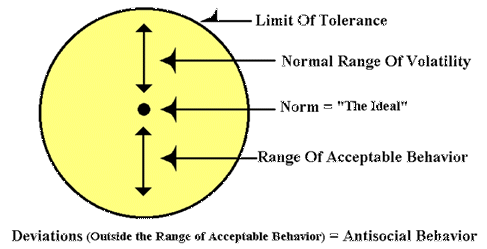
Whatever scale of differences we use to measure social interaction, we can think of diversity as equivalent to volatility, and homogeneity as representing stability. It is obvious, by definition, for the norm to represent a central social consensus or homogeneous position. The norm represents a central point that embodies the concepts that the society was formed around. The norm represents the "ideal citizen" of the society. In the real world there is no such thing as perfection, so a certain amount of variation is accepted. The range of deviation from the norm in any society is a measure of the diversity in the society. Every social group and every society is defined by a norm and a normal range of acceptable variation, or individual diversity, around the socially acceptable norm.
Within the normal range of volatility (the range of acceptable appearance and acceptable behavior) we find tolerance. Tolerance is a form of dynamic tension between the forces that drive members to preserve the norm of the society, and the forces of diversity that allow individual expression. The Nomothetic Theorem tells us that there is a limit to the normal range of volatility. In a social system, an extreme difference, or in other words diversity that extends beyond the limits of the normal range of acceptable behavior, evokes intolerance. Diversity in the form of unacceptable appearance or unacceptable behavior threatens the fabric that holds the society together.
The system preserves itself by enforcing a code of conduct that rewards the preservation of the norm of the society and punishes anything that threatens the stability of the society. Thus there is a limit of tolerance. Anything beyond this limit is considered deviant behavior. It is considered antisocial behavior, and it is not tolerated. Laws protect the society from individuals who are excessively deviant. Social relationships are also designed to protect the society. One form of social punishment is discrimination. Discrimination is the manifestation of intolerance, the intolerance for attributes in an individual that are perceived as deviating too far away from the norm of the society. Discrimination is the result of discomfort among the members of the society, discomfort from an appearance or a behavior that deviates sufficiently from the norm so as to threaten the homogenous fabric of the society. A social system is a dynamic complex system that fits neatly into the framework of the Nomothetic Theorem. All the corollaries and conclusions of the Nomothetic Theorem are equally useful in complex social systems, even though they cannot be easily quantified in mathematical terms.
 |
Racial and cultural issues are typically inflammatory and emotionally charged. It is hard to objectively approach the issues and perhaps impossible to quantify them in any meaningful way. But they can be logically addressed, without making value judgements, through the Theories of Stability and Volatility. Let us consider skin color as an example.
Imagine a society that has a spectrum of skin color from very blue, to purple, to very red. Solely for illustration, let us suppose that in our hypothetical society the ideal skin color is very blue -- perhaps because the blues hold the primary social and economic power. The problem is, although unblemished pure blue skin may be the desired ideal, it is not attainable by most people. The norm is defined not by an ideal, but by what is physically attainable and socially enforceable. Therefore, the norm will be somewhat less than pure blue, and there will be a range of tolerance for people who are on either side of the norm (pale blue to darker purple with reddish tint). But there will be intolerance for people with skin color beyond a certain limit of purple that leads to red. This hypothetical society would then appear to be predominantly blue with those people of redder complexion being outcasts.
Knowing how genetics work, the Nomothetic Theorem allows us to predict with a high degree of certainty that this is an unstable system and it will eventually evolve toward a purple skin color becoming the acceptable norm. Two key premises that lead us to this conclusion are: 1) Blue is at the extreme end of the scale. You can't get bluer than blue. 2) Mixed marriages result in mixed skin colors. This isn't like sex determination, where you can only be either male or female. Genetics say that the majority of people will eventually trend toward a middle shade of color. (Assuming color has no relation to fertility rate or survival rate.)
The Nomothetic Theorem tells us that the social system will seek stability. Since blue is an extreme, most people will not be blue. Therefore, pure blue can never represent the consensus and the norm. Even as an ideal, it will become less and less attainable (without selective breeding), and therefore less and less realistic as an ideal. The norm, and the accepted range of tolerance, will move increasingly toward purple skin and away from pure blue. Do you remember we talked about entropy and the second law of thermodynamics? Entropy works with genetics also. Once characteristics are mixed genetically, they remain mixed, i.e. at a maximum level of entropy, unless an outside force is applied. In this case, the outside force could be selective breeding. But even if the society discourages marriages with red skinned people, there is always going to be some crossover at the boundary of what is acceptably blue and what is not. The same is generally true if we were talking about economic status or any other means of social differentiation. When you start from an extreme, the greatest influence is going to be at the border areas of tolerance where the greatest pull is exerted. Over time, the norm for skin color is going to shift to the middle ground between the two possible extremes. Eventually a pure blue skinned person may be regarded as unusual and undesirable and as much a deviation from the norm as a totally red person.
Again, without making a value judgement, it can be argued that Adolf Hitler was behaving in an entirely rational manner within the framework of his beliefs. Although I am confident that he did not perform any logical analysis using the Nomothetic Theorem, he did intuitively understand that exterminating the people he considered undesirable was a necessary part of preserving what he saw as an idealized norm. If he did not totally remove the opportunity for tainted blood to mix with his ideal, it would have inevitably happened, and the norm of his Aryan race would have shifted away from his ideal. This in no way justifies his policies. In fact the Theory of Volatility tells us the logic is flawed. However, Hitler was dealing with the boundary problem by eliminating the existence of a boundary. Although unpleasant, this is an objective look at the issues that arise when confronting the goal of creating a super race.
The flaw in carrying this logic too far is that nature has a way of introducing its own volatility. Even if Hitler had successfully eliminated everyone who was not within an acceptable genetic range, successive generations would have mutated and created genetic variations that would fall outside of the originally defined range. This raises the philosophical question of how much can we control our world, and how much should we try to?
Just as it is inappropriate to try to build a completely homogeneous super race, it is perhaps equally inappropriate to try to stop the natural extinction of plants and animals that occurs regularly. Extinction has been a part of the world ever since life began. Although we shouldn't promote extinction, how hard should we fight to prevent it? Extinction is an example of a species deviating too far away from the norm of attributes necessary for survival. We can actually look at this issue on several levels of scale from individuals, to species, to phyla, to larger groups of life forms. If an individual animal is born with physical differences that deviate too far from the norm, or if the individual adopts behavior that is too far from the norm, it is typically a social outcast and often will not survive if its physical differences affect its relationship with its environment. The same is true with species and whole groups such as the Mesozoic reptiles (known as dinosaurs).
When looked at objectively, one can say that many of the world's current, well intentioned, and seemingly politically correct movements and policies may be misguided. Where is the boundary between an individual or species that is close enough to the norm to be included and helped, compared to a genetic failure that should be allowed to meet with extinction? Because we, as a society, have trouble drawing this line, we tend to try to be all inclusive. However there are many cases where the social cost of trying to save something that is unsaveable, or should not be saved, exceeds any benefit that might be realized. We tend to promote diversity as a way of worshiping individual worth regardless of the offsetting liabilities. But whether we are talking about an endangered fish, a spotted owl, a species that has evolved inadequately, or a mutant individual such as a severely handicapped human, it is important to maintain a balanced perspective between survival of the individual and survival of the society and survival of life on a larger scale. If a force keeps altering the internal rules of a system to protect the weakest parts of the system, then stability is being threatened and several consequences are possible: the system will need to reorganize to find a different path to stability (thus the very nature of the system may be radically changed), the system may disintegrate and its components will be absorbed by other systems (this is a more extreme level of the first case), or the changes are insufficient to prevent the evolution to stability (they only introduced a temporary cost in the form of volatility and delay).
The United States is a good microcosm of tolerance. The United States of America is historically thought of as a "melting pot" of race, creed, and religion. The strength of the country is believed to originally have been built on the ethnic and cultural diversity of the many immigrants who came to a new land to start over and become "Americans". Although social grouping in colonies was important when this land was first settled, it was largely the individual effort by pioneers that caused America to grow in the early days. Powerful images that worship the unfettered will of the individual at the American frontier are found in numerous legends of characters such as Davy Crockett, James Bowie, Daniel Boone, Johnny Appleseed, etc.
Ironically, the very diversity that is acknowledged as the society's underlying strength was quickly blended together (entropy at work!) and there arose from the melting pot a consensus regarding an ideal norm known as "the American dream". Although such a norm did not actually exist, there was such rapid progress toward a higher standard of living that a projected norm was imputed as attainable. It started with the industrial revolution which was well established in America by 1800, having come from Europe where it began in the mid-1700's. The dream was fostered by the ability of the common man to move from an agricultural form of subsistence to a new level of economic freedom found in the cities. The American Civil War both interrupted and stimulated the industrial revolution. Over the next hundred years after 1860, the productivity of the American worker increased almost ten fold. The benefits began to be clearly obvious by the end of World War I. There were dramatic increases in the country's gross national product, individual's disposable income, and the standard of living. By the 1920's it seemed that America's streets were truly paved with gold and everyone wanted a piece of the good life. Many new immigrants who came for a better life in America thought they were leaving the dark ages of their former lives behind them and wanted to erase all trace and memory. They would refuse to let their children speak their "old country" language, and the family would try as hard as possible to become fully assimilated with the consensus culture of their new country. There was a sense of pride in America and desire to be a team player to reap the benefits of this rich country.
Disillusionment set in with the great depression. But often adversity causes people to group together even more tightly. This was certainly the case when the country was confronted by foreign threats during World War II. After two decades of war and depression, Americans in the 1950's had a great desire for stability and security. Far beyond just abiding by legal statutes and regulation, there was general agreement to behave according to a code of manners, morals, responsibility, and trust. Homogeneity was at the root of communal life that led to stability. The cost that was willingly paid for this stability was lack of tolerance: some limitation on choices, some loss of individual freedom, and acceptance of authority for the greater good. The advent of mass communication further promoted a consensus ideal. The belief in assimilation perhaps reached a peak in the 1950's with the portrayal of George and Gracie Burns, the Cleaver family, and the Nelson family on national television. But the American dream of the 1950's was not the norm and did not include the blacks, Hispanics, native Americans, and other groups who could never fit into the all-white pictures being portrayed on TV. Racial strife had to inevitably come to the forefront.
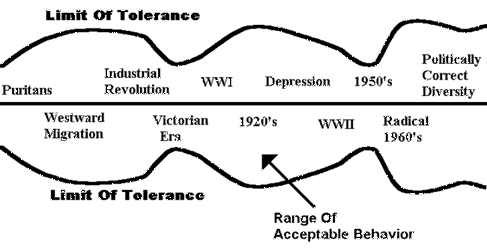 |
The cultural revolution of the 1960's spawned a hostility to cooperation as individualism and anarchy replaced communal authority. The consequence of attempts to resolve racial conflict resulted in the previous desire for an idealistic homogeneity eventually giving way to a new sensitivity for preservation of native cultures and respect for race. A dynamic tension has now developed between a desire to belong to a homogeneous group and a celebration of diversity for diversity's sake. But as individual freedom, the right to personal choice, and a reverence of cultural differences has become more predominant, we have incurred a different (and some would argue a much greater) cost in the form of less stability, more anxiety, hostility, alienation, violence, and isolation. As with any social situation, there is an accepted norm and inevitable variations around the norm. But when the variations are allowed to become too great, if tolerance is pushed to an extreme, then new problems arise. If we try to construct a society of unlimited choice and individual freedom, we are subject to a high degree of random volatility that threatens each individual in many ways. With the breakdown of manners, morals, and authority, we lose trust, loyalty, and commitment that is the glue for successful relationships. Without consensus and cooperation, we lose predictability. And as the society destabilizes, its individuals become at risk to threats that may far exceed the constraints that would have been placed on them by a less tolerant society.
For any society to function efficiently, some minimal diversity should perhaps be encouraged. But it is important to discriminate between diversity and antisocial deviance. It is not constructive to tolerate any amount of criminal or antisocial deviance. A problem occurs when people confuse diversity with antisocial behavior. The United States went through a period when graffiti was celebrated and hung in New York art galleries. But willful vandalism and the destruction of people's sense of security and ownership is antisocial. Graffiti is in fact a crime. Beyond mere vandalism, urban graffiti criminals are explicitly stating that a given turf is theirs. They are marking a boundary for other antisocial behavior. If society does nothing, it is agreeing with the criminal. If society confuses deviant antisocial behavior with diversity, it is apt to accept into the cultural norm activities that should be excluded.
Deviant behavior, at any level, is a threat to the norm that the majority have a vested interest in preserving. However, diversity within the normal range of volatility, far from being a threat, may be an enriching resource. Nevertheless, it is logical for diversity that challenges the limits of the normal range to be met with increasing intolerance. The reason increasing diversity is met with increasing intolerance is because extreme diversity starts to become antisocial by its very nature.
In America, the Christian tradition (as well as other religions) teaches tolerance. A little tolerance is good. But a society that becomes too tolerant becomes too diverse and too lax. A society that is too diverse ceases to be a society and becomes a collection of individuals living in anarchy. There is common reference to "the fabric of society". The fabric is made up of laws, regulations, manners, family values, religious values, and acceptable modes of behavior. When the fabric disintegrates, all of the strength, protection, and advantages that the society offers disappear. A society that is too diverse and has no commonality cannot function.
If we place such a high value on individual worth, then why bother to form a society if it does not serve the individual? If we tolerate the widest possible extremes of diversity, then we start to lose the definition of society. In fact, why even draw the boundary at the human race. (I know some people who might be left out if we just thought in terms of human beings!) Why not include monkeys and apes? But then why not include all animals? Isn't that what the animal rights movement is about? Further, why not include all things on the planet? -- one giant group, all with equal rights: plant rights, mollusk rights, mosquito rights, carnivore's rights, murderer's rights, victims rights . . . Wait a minute! Do we have a problem here? When individual needs or desires are in conflict, individuals of like type typically band together for support. Isn't that how societies are formed in the first place?
Remember our hypothetical blue society? Suppose the red skinned people decide they don't like being outcasts. They leave and form their own society in which red is beautiful. Now we have two separate societies. But inevitably there is going to be a border between them. If you think about it, every war, every conflict, starts at a boundary. The fighting may progress very quickly to bombing a capital city or taking out a leader, but the initial conflict is always over a boundary: a geographical boundary, a religious boundary, a boundary of possessions or behavior or ideals or values -- it is where two systems meet or intersect.
The primary advantage of a social system is the protection and survival of the norm about which the individuals have grouped themselves. When one strange individual meets another stranger, the results are hard to predict. But when a strange individual meets the boundary of a homogeneous society, the strength lies with the society. The members of the society understand the advantage of their membership. They depend on the society and the society depends on them. This mutual interdependence operates on shared values that result in predictable behavior. Without predictable behavior, the society cannot function. Therefore, any deviation that causes unpredictability threatens the society and triggers penalty sanctions.
It should be apparent that the greater the external threat, the stronger the society needs to be. Since a society's strength comes from homogeneous, predictable behavior, we can deduce that a greater outside threat causes a smaller range of tolerance. In other words, when times are easy we can have very loose societies with a wide range of tolerance. But when times are tough, people reorganize and pull together and subrogate their individual freedom and expression of diversity to the benefit of a group through whose strength they hope to ultimately survive and triumph in their shared values.
Don't you love the yinyang of it! The dynamic tension between individual rights and the needs of society are fascinating. And at the heart of it is the issue of survival. Survival of who? The individual or the society? Which individual? And which society? And then of course there is the issue that goes beyond the here and now: it is the question of adaptation.
I have focused on how important it is for the society to be homogeneous in order to function efficiently. But is there a danger of being too much alike and too predictable? What happens when the environment changes? How do societies adapt? The answer of course is diversity! Just as species need genetic diversity in order to adapt and survive, societies and all complex systems need some diversity if they are going to evolve.
Here we can branch off in two basic directions. One direction takes us to complexity, the other to simplicity. As an example, imagine an organism that lives at a stable 96 degree temperature. If the predominant temperature in its environment changes to 72 degrees, the organism has two choices for survival. The simplest choice is to adapt itself to live at 72 degrees. Assuming there is sufficient time for the organism to transform itself through successive generations, it may find a new configuration that allows survival at the new temperature. Another choice, given enough time, is that it can learn to insulate itself and maintain its original temperature of 96 degrees. If the temperature in the environment then becomes unstable and fluctuates from 70 degrees to 100 degrees who will be most likely to survive? The answer depends on how fast the temperature fluctuates. Choice number one works if the organism can reproduce fast enough to keep adapting to each new temperature. Choice number two, although requiring a more complex structure to begin with, appears to be the better route because no further adaptation is necessary.
If you understand the advantages of adapting toward complexity and believe in a pure model of 'survival of the fittest', then it is no surprise that humans control the planet. The most complex animal is also the most versatile and can deal with many different situations in many different environments. Humans have learned to live under the ocean and on the moon. You can't say that about cockroaches! But there may be one large pitfall to adapting toward complexity. The more complex and successful an organism becomes, the less the need for further adaptation. In fact, if, as humans have done, an organism is able to start controlling its environment, then it has less need to adapt. Eventually, if it exerts enough control over its environment, it may lose some of the abilities that allowed it to survive in a more hostile environment. How many humans do you know, living in a major metropolitan city, who could survive if lost in the woods of Canada or the jungles of South America? As individuals, humans have lost many skills and some physical abilities. As a species, how quickly could humans genetically adapt if there was a major change in the environment? It is certainly arguable that a single celled organism that can replicate thousands of times in an hour and millions of times in a day has a better chance for genetic adaptation than the human race that (even with billions of people reproducing) may take decades or centuries to find an appropriate genetic adaptation.
The same logic applies to social systems. I look at the Internal Revenue Code of the United States with all of its amendments since 1954 and wonder how much longer it can survive in its complexity. I look at legal systems around the world that have evolved toward complexity and wonder how effective they can remain. Can you keep the heart of a system and still allow it to evolve in simplicity? Or if you want to preserve an ideal, do you have to keep building a more complex structure around it, constantly patching and repairing, to insulate and protect it from changes in the environment? Of course ultimately this goes to the whole issue of mortality. To what extent does the individual live for itself, and how valuable are its unique characteristics, versus to what extent is the individual simply a conduit to pass on its DNA code or the essence of its life form?
Let me leave you with that thought for a moment and move to another topic related to system structure. In addition to the issue of adaptation and survival over time, there is the issue of defense from immediate attack. Component construction is the thing that makes many systems so robust in the first place. When you cut through a hemp rope, it loses strength fiber by fiber. There isn't an all-or-nothing break. The human body dies cell by cell. A single bacterium cannot effectively attack a human body. The power of bacteria and viruses to cause disease comes from their ability to rapidly replicate. A single salmonella bacterium can multiply to more then ten million bacteria in five days. A deadly attack of food poisoning results from the bacteria successfully overwhelming their host by attacking so many cells that the systems' defenses are swamped. Once the human body can no longer clean out wastes, maintain temperature, absorb oxygen and nutrients, coordinate functions through nerve impulses, etc. the system breaks down and death results.
Different attacks require different system structures for effective defense. Suppose a strain of bacteria was smart enough to focus only on one vital organ. If only heart muscle was at risk from a specialized attack, then having two hearts might be the best defense. Engineers who know the value of redundancy build in multiple backup systems in critical equipment on airplanes and space rockets. In other cases, decentralization is the best defense. If there is no vital center, such as a heart or a centralized brain, then the enemy is forced to attack all components. If every house had its own power source, then a catastrophic failure of an electric utility system would not be a concern.
I have already cited the individuality of the early American pioneers. By analyzing system structure, one could say it was a foregone conclusion that the British would lose the American Revolutionary war. British soldiers would only fight as a unit under a central command. The American militia was a loosely knit group of individuals who fought for an individual belief in freedom, not because they were part of any army. If you faced an individual American patriot against an individual British soldier, the American would fight. The British soldier had little motivation except to return fire to save his skin. Thus, when the British military system broke down in Concord, Massachusetts, the British soldiers, as individuals, ran all the way back to Boston while the American patriots, who were barely organized in the first place, chased and fought the British even though they had no military plan or tactical organization during the British retreat.
You might want to conclude that the course of the war simply resulted from the American tenants protecting their land and ideals while the British invaders had less motivation. But consider what happened to the true natives, the American Indians when they fought the same pioneers. The Indians operated under a tribal hierarchy that was in many ways just as rigid as the hierarchy of command in the British army. Surely the Native Americans had a strong motivation to keep and defend their lands from the invading white men. But as soon as an Indian Chief was talked into signing a peace treaty and moving to a reservation, the rest of the tribe usually went along. The Federal government and various state governments did not have the same control over the white settlers that the Indian chiefs had over their tribe. Individual settlers would constantly violate government policies and create situations that resulted in armed conflicts, ultimately to the detriment of the Native American Indians. The American Indians were confronted with a pestilent swarm that had no vital center that they could identify to attack. No matter how many individual white men they killed or scared off, there were always more. Like bacteria multiplying and overwhelming their host, the Indians could neither contain nor eradicate their enemy. The lack of centralized control, combined with a tacit group organization that stemmed from similar motivations, was the strength that conquered and settled America.
In summary, the Nomothetic Theorem focuses attention on the norm in society: that central consensus that binds the individuals together in the first place. The strength of the society depends on the strength of each individual's tie to the norm. If the motivation to conform is held internally by each individual, the system (society) will be more robust than if the individuals are tied together by some hierarchical system (force of government) that is more centralized and subject to attack or internal breakdown. Around the norm, a certain amount of diversity is tolerated, but increasingly significant deviations must be met with increasingly greater intolerance, or the society will disintegrate. Societies may be formed based on an ideal, but the norm will evolve in the direction of what is practical. Perfection is not practical, and it is easy to predict that the mutts will prevail, not the purebreds. However, volatility will keep introducing new variations, and the process of adaptation suggests that the norm will keep trending in the direction of the newest variation that is best equipped to survive in the environment of the time.
One of the features that is unique about social systems is that each individual has a choice. Whether we are talking about clothes, hair style, attitude, behavior, religion, belief structure, or any of many other choices, if an individual is too far away from the norm, there are three choices available: 1) They can change and move toward the norm, 2) They can remain the same and in conflict with the system, 3) They can secede from the group and form their own new group with a new norm.